

Australia's AUKUS submarine plan is being reshaped by American and British constraints, raising questions about whether the promised leap in capability is quietly becoming a compromise. ProfessorVince Hooperwrites.
WHEN THREE defence ministers meet on the sidelines of theShangri-La Dialogueand emerge with a streamlined plan, it pays to read the small print.
Thecommuniquthat Defence MinisterRichard Marles, U.S. Secretary of WarPete Hegsethand UKSecretary of State for DefenceJohn Healeyreleased in Singapore on 30 Mayannounced that Australia would now acquire three in-service Virginia-class submarines from the United States, in place of the previously agreed mix of one newly built boat and two used ones.
Cost savings, supply chain simplicity, operational efficiency, the official narrative was polished and the headlines obliged.
The story Canberra is not telling is more uncomfortable. Australia has not simplified its submarine acquisition. Australia has been handed what Washington could spare.
Under the optimal pathway unveiled in 2023, Australia was scheduled to receive three Virginia-class submarines beginning in the early 2030s: two transferred from the United States Navy and one freshly minted from American production lines.
AUKUS ties nuclear anchor around Australia's neckThree years ago, Anthony Albanese signed Australia up to quite possibly the worst deal in our history.
That third boat mattered. A new Block VII Virginia would have arrived with a full reactor life ahead of it, the latest combat system and the longest possible service horizon before SSN-AUKUSconstruction begins in Adelaide late this decade. It was the part of the deal that gave Australia a stake in the cutting edge rather than the back catalogue.
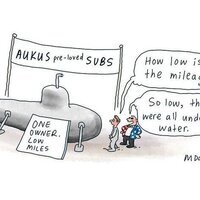
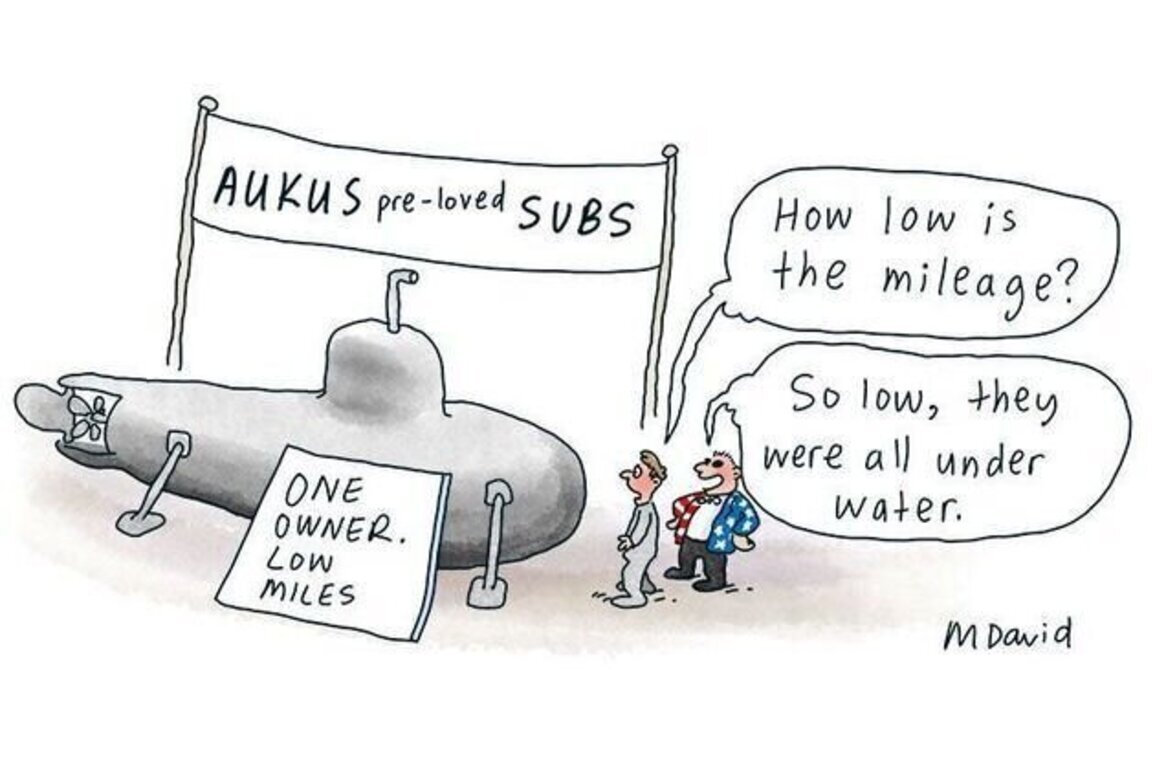
It is gone. All three boats will now be drawn from existing U.S. Navy inventory,Block IV hulls whoseremaining reactor years and platform agewill, as one defence analysis dryly observed, directly shape Australia's undersea combat capability through the 2030s. The number of submarines is preserved on paper. The quality of the capability is not.
Marles told reporters in Singapore that Australia needed toplace a premium on simplicity.That is one reading. TheAustralian Strategic Policy Institute'sEuan Grahamoffered another: the glass-half-empty version, he said, is that we are dealing with a curtailment of Australia's ambitions for Virginia-class submarines because this is all the Americans are willing to give us.
Graham is not a contrarian voice. He is a mainstream Indo-Pacific analyst describing, in measured terms, what the deal actually represents.
The supporting evidence arrived almost immediately at home. Defence SecretaryMeghan Quinntold aSenate committeethat second-hand submarines had always been the preference, before clarifying, under questioning, that the project had two constrained optimal pathways.
Two constrained optimal pathways is bureaucratic language for a preferred plan and a fallback plan, with the fallback now reframed as the original intention. Defence Industry MinisterPat Conroywent further, conceding that Washington had changed its mind about which Virginias it wanted to keep and that Australia was adjusting accordingly. The candour is welcome. The implication is awkward: the most consequential defence procurement in Australian history is now timed to American shipyard convenience.
Why has it come to this? Because the U.S. submarine industrial base cannot deliver. American yards have been building Virginia-class boats at roughly1.13 per yearagainst a U.S. Navy target of two, a backlog the Pentagon itself acknowledges and one that is unlikely to be resolved before 2028. Stripping the new build boat out of Australia's allocation eases a production bottleneck in Connecticut and Virginia. It does not ease anything for the Royal Australian Navy.
Australias $300b AUKUS bet hinges on Britains submarine capacityThe arrival of Britains HMS Anson in Western Australia highlights the historic ties, industrial risks and strategic stakes behind Australias $300 billion AUKUS submarine pact.
The British leg of AUKUS is in no better shape. The Royal Navy currently operates a small Astute-class fleet, several of whose boats are tied up in extended maintenance at the Devonport dockyard in Plymouth. HMS Audacioussat alongsideat Devonport for some 22 monthsafter returning from a record-length 2023 deployment, not because she was being worked on, but because the dry dock she needed (Number 15) had not been reconfigured in time to receive an Astute-class boat. She was finally taken into the dock in April 2025.
HMS Ambush, meanwhile, is understood to be atvery low readinessand substantially stripped of partsto support other boats. The UK Defence Committee,reporting in late April 2026, weeks before the Shangri-La announcement, warned that submarine availability was critically lowand that without urgent infrastructure investment at Devonport and Faslane, Britain would not be able to meet its AUKUS obligations and maintain its Euro-Atlantic deterrent commitments simultaneously.
The UK Government has earmarked 4.4 billion (AU$8.3 billion) for Devonport upgrades and signed a 750 million (AU$1.4 billion) Babcock contract for new submarine facilities, but those investments will not bear operational fruit for years. The AUKUS clock is now.
The events around HMS Anson illustrate the overstretch with uncomfortable clarity. The Astute-class boat sailed from Faslane on 10 January 2026 and arrived at HMAS Stirling in Western Australia on 22 February, for what was billed as thefirst maintenance periodever conducted on a UK nuclear submarine in Australiaand a milestone in the build-up toSubmarine Rotational Force Westin 2027.
The symbolism was important. The training value was real. The visit was also short-lived.
On 6 March, only 12 days after arrival,HMS Anson wasabruptly withdrawnfrom HMAS Stirling and redeployed to the Arabian Seain response to the U.S.-Iran conflict the only operational Astute-class boat the Royal Navy had to send.The Diplomatput it bluntly: the question was not where Anson had gone, but why that submarine specifically needed to be pulled from Australia.
The answer was that there was no other option. The Defence Committee's report later cited the episode directly, concluding that AUKUS commitments had stretched the Astute fleet to, or even beyond, its limits. The boat eventually surfaced in Gibraltar in May, on what looked like its way home for maintenance. AUKUS Pillar I, in other words, lost its inaugural UK rotational presence in Australia within a fortnight, to a Middle Eastern contingency Britain could not refuse.
Funding firestorms: Washingtons war habit and Canberras silenceAs U.S. and Israeli strikes on Iran escalate, billions flow into conflict while Australia backs the alliance without question.
This is the full picture Australians should hold in mind. AUKUS Pillar I is not a partnership of three navies each operating from a position of strength. It is a partnership in which Australia is asked to accept whatever capacity the American and British submarine enterprises can spare, on the timelines those enterprises can manage, with the qualitative trade-offs absorbed by the junior partner.
The bridge capability that Pillar I was meant to provide between the ageing Collins class and the SSN-AUKUS built in Adelaide just got narrower.
There is a further question Canberra has not been pressed to answer. The original 2023 framework left open the possibility of up to five Virginia-class boats being transferred. The Singapore announcement mentions potential for up to two more later. Three plus two is still five, but the second tranche is a political promise from successive American administrations across the 2030s, made by a Pentagon already unable to keep its current build rate.
ASPI'sMalcolm Davis has flaggedthat the Government needs to clarify whether the United States remains genuinely committed to the larger figure, or whether five has quietly become a ceiling of three. If it's the latter, Davis observed, we'll have to make do with three second-hand boats. The difference between five and three is the difference between a credible Indo-Pacific deterrent contribution and a token presence.
None of this is an argument against AUKUS. The strategic logic of nuclear-powered submarine cooperation with the United States and the United Kingdom is, on balance, sound. The PLA Navy is launching boats faster than the U.S. can and Australia cannot indefinitely deter undersea threats with a half-dozen ageing Collins class diesel electrics. The pact has a coherent geopolitical rationale.
But coherent rationale is not the same as honest accounting. The Albanese Government won the AUKUS debate at home by promising Australians a leap forward in capability. What was announced in Singapore is a leap sideways at best, with the qualitative ceiling lowered and the production calendar handed to a partner whose yards are at capacity for the next 15 years.
Marles can call that simplicity. Australians watching their alliance partners struggle to keep their own boats at sea and watching the inaugural UK rotation in Western Australia evaporate within two weeks are entitled to call it something else.
The Tamar at Plymouth and the Clyde at Faslane are a long way from HMAS Stirling. The submarines that are meant to bridge them are, increasingly, the submarines that Washington and London can afford to part with. That is the AUKUS announcement Shangri-La produced. It deserves a more candid hearing than the one it received.
ProfessorVince Hooperis a proud Australian-British citizen and professor of finance and discipline head at SP Jain School of Global Management with campuses in London, Dubai, Mumbai, Singapore and Sydney.
Related Articles
- Australia didn't vote for this war, but it's fighting it anyway
- AUKUS ties nuclear anchor around Australia's neck
- Australias $300b AUKUS bet hinges on Britains submarine capacity
- Mark Carneys warning: Albanese is choosing weakness for Australia
- AUKUS and the submarine illusion: Australias $368 billion surrender